
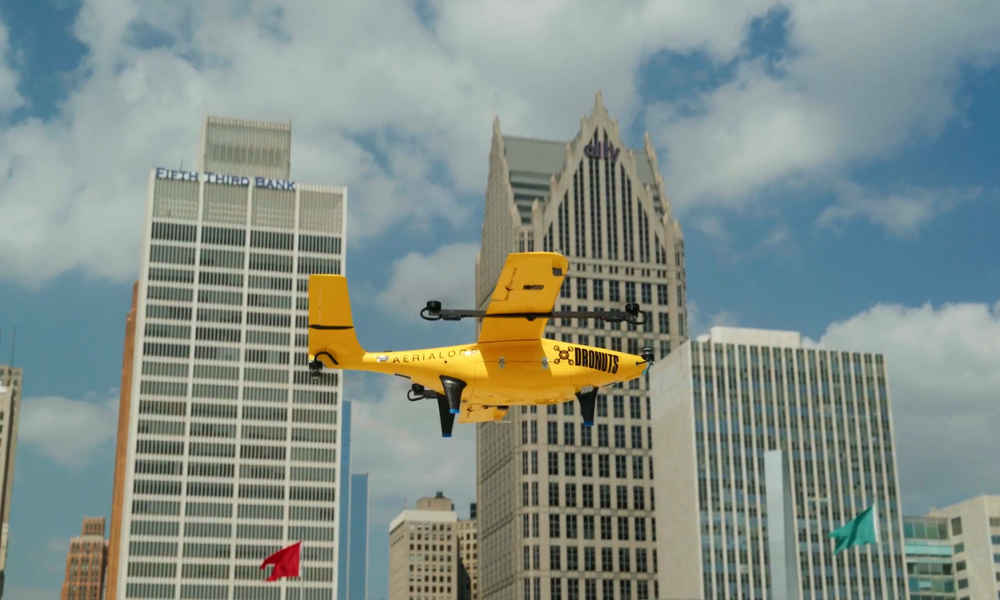
The XPONENTIAL 2026 conference took place at Detroit’s Huntington Place during the week of May 11. Organized by Association for Uncrewed Vehicle Systems International (AUVSI), the conference brought together companies, researchers, government agencies, and mobility leaders from across the autonomous systems industry. While the spotlight was clearly on commercial aerial drones, the conference also serves as one of the leading global events focused on autonomy applications across aerial, ground, and maritime platforms.
Discussions throughout the conference reflected a commercial drone industry that is rapidly moving from experimentation toward scaled deployment and operational execution. At the same time, some presenters acknowledged that commercial drones do not evolve at the pace of consumer electronics – meaning that regulatory complexity, operational requirements, and infrastructure constraints mean innovation cycles are longer and investment decisions can carry significant risk.
Real-world deployment examples demonstrated how quickly the industry is advancing. Amazon’s drone delivery operations in Phoenix were cited during conference discussions, with the company reportedly reaching approximately 45 deliveries per hour — its highest delivery volume of any region where it has deployed drone delivery service. Amazon also started drone delivery service from two distribution centers in the Detroit Region in the fall of 2025, with plans for continued service expansion in the region.
The rapid advancement of these technologies is also critical for defense applications. XPONENTIAL 2026 was co-located for the first time with the Michigan Defense Expo (MDEX), bringing together commercial autonomy firms, defense suppliers, advanced manufacturers, and government stakeholders. Conference presenters highlighted the additional military capabilities autonomous drones can provide, including logistics support in challenging locations, the potential for aerial drones to deploy ground-based autonomous vehicles in dangerous environments, as well as surveillance and other applications.
Battery technology emerged as one of the most consistent themes across XPONENTIAL conversations. At the LIFT Detroit workshop, for example, participants identified batteries as the single most critical technology issue affecting future drone development and deployment. The challenge extends well beyond energy density alone. Lightweighting, structural mass reduction, charging efficiency, and thermal management all directly affect flight time, payload capacity, speed, and operating economics. The Detroit Region’s expertise in electrification and advanced manufacturing aligns closely with these emerging industry needs and presents a critical opportunity.
The conference also highlighted the growing importance of workforce development as the sector matures. Several companies discussed drone manufacturing and engineering programs designed for middle and high school students, reinforcing the idea that advanced aerial mobility is already shaping future talent pipelines.
The conversations and exhibits at XPONENTIAL 2026 pointed to an increasingly connected mobility ecosystem where automotive, aerospace, autonomy, and advanced manufacturing capabilities are converging rapidly. The Detroit Region’s expertise in many of the necessary technologies and processes serves as a critical foundation for the attraction and support of the companies that will develop and build the next generation of these exciting vehicles.
To find out more about the mobility technologies and products that are powering the future of the Detroit Region, visit the Road to 2030 website or click here to learn more about the region’s mobility industry.